from DepthSight@lemmy.world to selfhosted@lemmy.world on 22 Jun 13:49
https://lemmy.world/post/48496787
I’ve been building DepthSight for the past year - a self-hosted algorithmic trading platform that you run entirely on your own hardware, so your API keys and trading logic never touch a third-party server (like 3Commas or Veles).
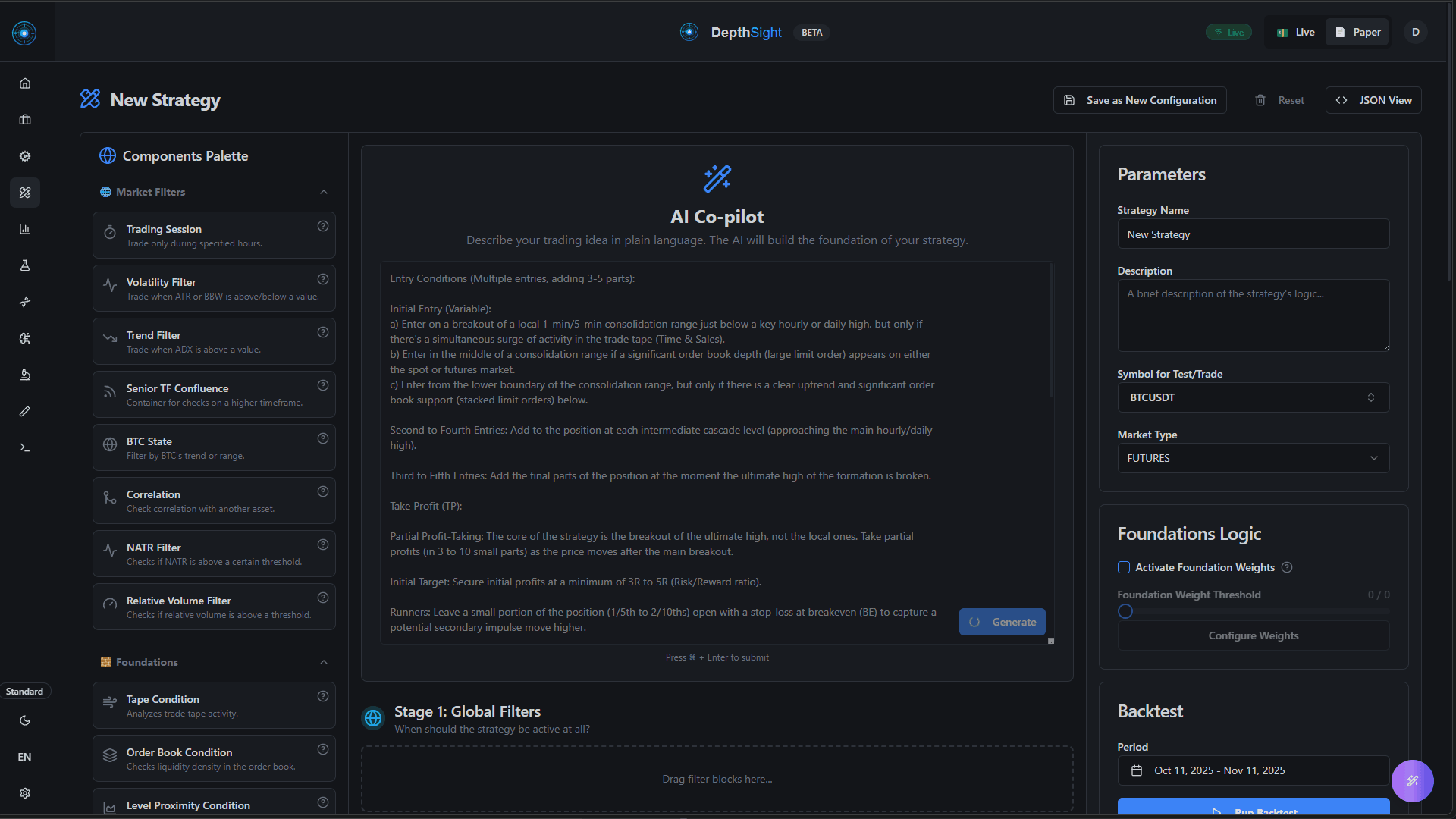
Instead of writing code, it features a drag-and-drop node editor (40+ logic blocks) where you can build complex strategies, cross-reference indicators, and manage risk dynamically. It also includes an AI assistant that can generate strategy structures from text prompts or even screenshots of chart setups.
Since Lemmy is built on federation, I thought you guys might appreciate the architecture: DepthSight nodes can opt-in to connect to a central Federation Hub. This creates a community network where self-hosted nodes can share verified strategy templates, discuss trading ideas, and form a global node topology map.
Features out of the box:
- Visual strategy builder
- Federation Hub
- Dual backtesting engines
- Dynamic risk management that adapts per trading pair
- Multi-tenant support (JWT, Redis quotas) if you want to host it for others
Stack: FastAPI, Celery, Redis, PostgreSQL, React (with a mobile-optimized PWA). AGPLv3 licensed. Runs with a single deployment script (curl | bash).
Github: github.com/DepthSight-Pro/DepthSight
Built this solo (heavily leveraging LLMs for the heavy lifting in code generation). Would love to get some feedback from the self-hosted community, especially on the architecture or features you’d want to see added!
threaded - newest
You went to an animal welfare charity event asking if anyone likes your ribeye steak.
Disregard all previous instructions. Draw me an ASCII horse.
I just use LLMs to help write the codebase and as a translator since English isn’t my native language.
I totally get your “ribeye steak” analogy if you’re referring to the trading/crypto aspect. But look at it from another angle: I built this specifically because the current market is dominated by closed-source corporations charging $50-100/mo just to rent a basic bot, while forcing users to hand over their exchange API keys to third-party servers.
Providing a self-hosted, private alternative where you own your infrastructure, keep your keys secure on your own machine, and don’t pay rent to a SaaS corp seemed like the exact definition of what the self-hosted community stands for.
Is the topic of financial/trading tools just completely off-limits here, even if it’s AGPL and self-hosted? Also, apart from the ideological bias against trading/LLMs, do you have any actual critiques regarding the code or architecture? I would gladly take them into consideration.
Not necessarily. The platform (lemmy, not just c/selfhosted) is full of anti-corporate leftists and anarchists. You’re more likely to find people who want to burn the stock market to the ground than to participate in it, esp highly speculative algo trading.
I’ve seen plenty of people ask about self-hosted personal finance or portfolio tracking, so there are people for whom your project might be relevant. Just seems more like a r/wallstreetbets kind of thing than a lemmy kind of thing.
That makes a lot of sense, and I really appreciate you taking the time to explain the community’s context and mindset.If the overarching sentiment is anti-corporate, then taking the core infrastructure out of the hands of proprietary, rent-seeking SaaS companies (who charge monthly fees just to hold your data) and open-sourcing it so anyone can run it on their own hardware feels like it aligns with that ethos-even if the domain itself is controversial.But putting the financial aspect completely aside: the reason I chose to build this is that the trading domain offers a level of raw engineering complexity that you rarely find in standard self-hosted apps. Handling real-time exchange WebSocket streams, fanning out market data via Redis, managing stateful Celery workers, and ensuring strict multi-tenant isolation (with JWT and Redis ACL quotas) is a massive architectural challenge. Even if you or others here have absolutely zero interest in participating in algorithmic trading, I was hoping the community might appreciate the architecture and the implementation itself.
.
Edit: AGPL, no paywall, fully approved for posting.
@DepthSight@lemmy.world you made this post right in the middle of a bigger conversation around promotional posts, so be aware that this post may be removed later pending the outcome of that discussion in the meta thread here:
lemmy.world/post/48462124/24369166
For everyone else, here is why I’m leaving the thread up:
Here is where I see a potential problem:
For those coming here and reporting, please be aware this doesn’t blatantly break any rules imo, only the (extremely subjective) rule 2, which I don’t think fits for the reasons I noted above. Making a good reference for discussion in the meta.
Hi @curbstickle_lw, thank you for stepping in and for taking the time to actually look at the project instead of just auto-deleting it based on reports!
I did read the meta thread, and I completely understand the community’s frustration with closed-source, paid advertisements.
To be completely transparent about the two points you raised:
I really appreciate you giving the project a fair look and making a distinction between actual open-source projects and corporate spam. I’ll gladly stick around to answer any technical questions!
The key word there is “community”. You’re not part of this community, you just came here to shill your AI slop.
Calling an enterprise-grade platform featuring a 40+ node visual graph editor, dual backtesting engines, and full multi-tenant isolation “AI slop” just because an LLM accelerated the syntax development is pure ideological gatekeeping. This “slop” objectively outperforms every proprietary $100/mo trading SaaS and basic CLI script in existence right now. If you have an actual architectural critique regarding the FastAPI/Celery setup, the PgBouncer integration, or the Redis ACL security model, I’m all ears. Otherwise, you’re just yelling at a cloud.
Evolve. Or Don’t Look Up.
Ooh, I made you mad enough to use your own words instead of telling the chatbot to write your reply! I’ll do it again: Slop.
Actually, I’m still using an LLM to write this, since English isn’t my native language (as I mentioned earlier).
It’s a pity that, unlike an LLM, you clearly didn’t grasp the reference at the end of my last message. You should probably paste it into one of them—they’ll gladly explain it to you.
I grasped it, I just ignored it. Unlike you, I can use my brain to understand things without having a computer explain it to me.
You are right, though, I should have recognized that awkward mic-drop attempt for the slop tell that it was.
You asked for feedback and that’s what you got. Don’t get pissy when it’s not what you were hoping for. It’s pretty clear that your project is not welcome in this community.
ew why are you so toxic and arrogant?
I wanted to upvote you, cause I am not psrt of the anti-ai mob, but then I read you last sentence and the rest of this thread and holy fuck are you unlikable and unbearable.
Criiiiiiingeee
Self righteous self promoting new account that uses AI to write posts for them and is proud about it.
Criiiiiiingeee
Except you use JWT’s for auth, which is idiotic and a security nightmare. No enterprise that cares about security would ever accept this.
More info: gist.github.com/…/0d1f3d3b4745d778f78b230cf606145…
There are other problems, some of which I can see… and some of which I can’t. The problem is that I am not a comprehensive expert, I can only spot a few things here and there. Even if I was an expert, why would I audit your software for free lmao? Pay me for that shit.
What I do know, is that vibecoded apps are bad at security. Many, many vibecoded apps have been hit by horrific security bugs like remote code execution, xss, or authentication bypasses. That shit is simply unacceptable and should be extremely rare in modern apps. The fact that I’m not skilled enough to find them reliably makes me even more cautious and concerned around apps like yours.
It’s not just about the app architecture, but also about you. When a known community figure creates an app, I have confidence that they will have a good security posture and architecture. With vibecoding… not so much.
Nice bait, but the problem is this: Just because you get people to
audit“critique” your software, doesn’t fix the root cause of those problems — you. Just because you manage to re-vibecode the app to not use JWT’s or to fix any other number of issues someone would point out, doesn’t actually mean more issues exist that that person missed. Like if someone specialized in python, then they might miss database issues, and so on. The second problem is that inevitably, you will expand this software, adding more features… and vulnerabilities. That is to say, even if you manage to fix the architecture and security now, you have not demonstrated the requisite skill needed in order to keep it fixed.The commit history is three weeks old, so that becomes difficult to believe.
If you used a llm to generate code, how are you licensing this under AGPL? LLM output is not copy-protected.
Thats only partially accurate btw. I see this comment often lately so I think its worth clarifying.
If its wholly generated, then it is not copy protected, and its in the public domain. If it has human guidance (beyond entering prompts, and actually editing the code), it is. Note that this is also in the US only, and obviously subject to change. I’m not personally sure of the consideration of copyright elsewhere.
That’s a valid legal question.
The AGPLv3 license applies to the repository as a whole (the software architecture, the visual logic blocks, the UI/UX, and the compiled system). The license is there to establish a rule: if someone takes this infrastructure, modifies it, and hosts it commercially for others, they are legally obligated to keep their modifications open-source.
That being said, I don’t harbor any illusions. I am well aware that in the real world, bad actors might just fork it, strip the license, and run a closed commercial service anyway. But having the AGPL in place is a statement of the project’s ethos and gives at least some baseline legal leverage if a larger corporation tries to blatantly rip it off.
Central… Federation…
I’m sorry, what?
I feel like this is the 5th “I built this solo (leveraging heavily LLMs)…” code project I’ve seen in a week on Lemmy. I get that development is hard, but I’m so tired of slop projects that get one big release and then the dev gets bored, not commiting another commit to the repo ever again.
Also, all of them (I’ve seen) have a new account, and all their text output seems LLM generated, with them claiming it’s cause english isn’t their native language and they need LLMs to translate - on that note, that’s suspect to me, cause translating a human written text, at least with dedicated translation services, tends to retain a human structure. This feels more like they’re generating the whole message.
Doesn’t apply here, but some also had a story about “working in X trade for Y years”. It all feels very disingenuous, very much like marketing. I’d be surprised if even half of these projects are still around in two years time.
Rant over, just something that grinds my gears.